

If you, as a B2B company, are publishing more content but the content is doing nothing for your pipeline, there is likely no connection between your content, buyers’ problems, and business goals. This scenario is often a result of a disconnect between your content and revenue teams, misaligned strategy, and a focus on vanity metrics, and can quietly drain your marketing budget. A familiar question you might have asked is, ‘Why is our content marketing not working, and how do we fix things? In this article, I’ll walk you through the specific reasons why B2B content fails and the practical ways you can create content that actually wins.
Key Takeaways
- Most B2B content fails because it’s built to rank for keywords and attract traffic that never converts into sales or leads. The content does little to nothing to influence buying decisions.
- The gap between content teams and revenue teams is a top cause of underperforming content. Content stakeholders who don’t have access to sales calls insights can’t address the objections that stall deals for the company.
- Winning B2B content starts with a clear point of view, maps to specific roles within the buying committee, and measures success against pipeline contribution, not page views.
- The shift from content-as-output to content-as-strategy requires cross-functional alignment between marketing, SEO, sales, product, and customer success.
- B2B SaaS, tech, and enterprise integration companies that connect every piece of content to buyer intent and a defined business goal consistently outperform those chasing publishing volume.
Why Most B2B Content Fails Even Before a Writer Touches It
Most B2B content fails because of six structural problems that often have nothing to do with the quality of the writing itself. This, I know, goes against the ‘norm’ of pointing fingers at writers for writing content that didn’t convert. I guess it’s easier to blame writers, the final executioners of a flawed content program.

Hear me out before you fire your next set of B2B content writers. Any or all of these six reasons might be why your content program fails.
1. Content is built to rank, not to influence decisions
Most B2B content I’ve seen starts with a keyword, not a buyer problem. Teams have refused to shake off a bad practice that has existed since the days of keyword stuffing.
- Open Semrush
- Pick a keyword that Semrush says gets 5,000 monthly searches, and
- Write something designed to rank and drive traffic.
A piece of content written with this approach succeeds on every traffic metric and fails on every revenue metric.
Consider a SaaS company in the project management space that publishes a blog post targeting “what is project management.” The blog ranks on page one, organic traffic spikes, and the dashboard looks impressive enough to get a marketing round of applause. But the people clicking are students writing papers and job seekers preparing for interviews, not B2B buyers evaluating project management tools.
Did the content rank and attract an audience? Yes! Just not the one that buys what the SaaS company is selling.
This happens because keyword volume and buyer intent are two different things, and most content workflows treat them as interchangeable. A keyword with 10,000 monthly searches and zero commercial intent is less valuable than a keyword with 200 searches that maps directly to a purchase decision.
Keywords still matter, but start every content decision by asking which buyer question this piece answers and at which stage of the journey that question matters most. The content should be able to influence purchase decisions for your company.
2. No clear point of view
Most B2B content reads the same because the content summarizes consensus instead of taking a stance.
Decision-makers are drowning in content that looks, sounds, and feels identical. The 2024 Edelman-LinkedIn B2B Thought Leadership Impact Report team surveyed nearly 3,500 management-level professionals in December 2023 for insights into how thought leadership can do more than just increase brand awareness. The team found that less than half of global buyers (48%) say the overall quality of the thought leadership they read is good, and only 15% describe it as “very good” or “excellent”.
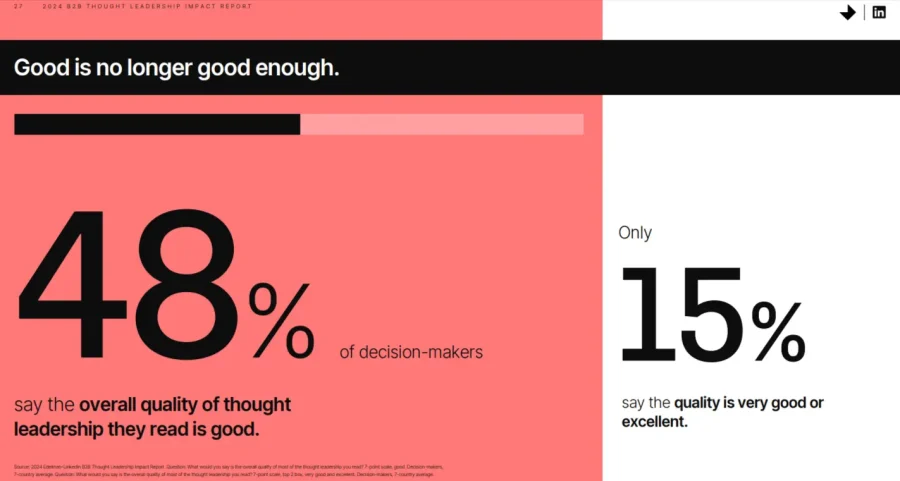
Source: 2024 Edelman-LinkedIn B2B Thought Leadership Impact Report
This is why B2B content has become ‘boring’. Five CRM companies all publish “how to improve customer retention.” Each post uses a watered-down version of the Skyscraper Technique to cover the same tactics, cite the same general advice, add a little extra, and arrive at the same conclusion. The reader finishes and remembers none of them.
The CRM company that differentiates, picks one clear point of view, and opens with something scroll-stopping. Something like, “most retention strategies fail because they focus on the wrong metric,” gets attention by reframing the problem and being just a breath of fresh air.
A point of view doesn’t necessarily mean being contrarian for attention. It means having a clear understanding of your product and market that shapes everything you publish. Without that, your content will blend in with others, and content that doesn’t stand out rarely builds a pipeline.
To learn more about how a clear point of view translates into content that actually performs, read How to Write Problem-First Blog Posts That Drive Traffic and Revenue.
3. Content teams are disconnected from revenue
Content is produced in a silo in many B2B companies. Writers don’t work closely with sales and customer success teams — sit in on sales calls, read CRM notes, or know which objections stall deals or which questions prospects ask before signing up. So they write about topics that seem relevant instead of topics that directly address buyer problems and questions at different stages of their customer journey.
I’ll admit that B2B content teams are beginning to wake up, but they’re yet to leave the bed. CMI’s 2026 B2B Content and Marketing Trends Report, a survey of 1,015 B2B marketers, found that only 45% of effective marketing teams credit alignment with sales as a driver of their success. This data from the report means that even among the top-performing teams, more than half still haven’t built a reliable feedback loop between the people creating content and the people closing deals and retaining customers.
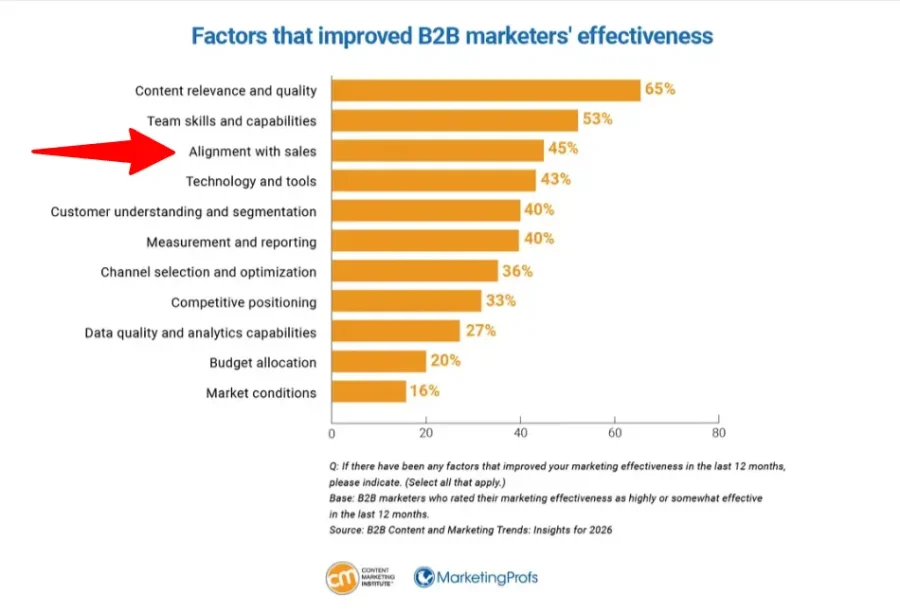
Source: CMI’s 2026 B2B Content and Marketing Trends report
I’ve seen this firsthand. When I worked with an enterprise integration company, the content team had no idea that “data migration risk” was the number-one objection on sales calls. They were publishing thought leadership on digital transformation trends while the sales team was losing deals over a very specific, addressable fear. Once we built problem-first content around that objection, a detailed guide on managing data migration risk, the sales team started sharing it directly with prospects. The content became a deal-closing asset because it spoke to what buyers actually cared about.
4. Content speaks to “the buyer” instead of the buying committee
B2B sales have a longer lead conversion time because B2B purchases involve committees: champions who advocate internally, technical evaluators who assess feasibility, and economic buyers who approve the budget. Content that speaks generically to “the buyer” misses the fact that each of these people needs different information to say yes.
Influ2’s 2026 Enterprise Buying Survey of 50 enterprise and mid-market buyers reported that 42% of buying groups had 5 to 9 members and 50% had 2 to 4. Each stakeholder arrives with independently sourced information, evaluates the vendor through a different lens, and has a different definition of what good enough looks like. Generic content systems that address a single buyer persona ignore how these decisions actually work.

Source: Influ2’s 2026 Enterprise Buying Survey
Take a marketing automation platform that writes one blog post about “marketing automation benefits.” The CMO reading it wants ROI data: How will this affect revenue and customer acquisition costs? The marketing operations manager wants integration details: Will this work with our existing tech stack without a six-month implementation? The IT lead wants security specifications: Does this meet our compliance requirements? One generic post can’t serve any of them well.
When you understand the different facets of the buying committee, you’d create content systems that answer everyone’s questions end-to-end.
5. Success Is Measured by Vanity Metrics
When content is measured by traffic, page views, and social shares, teams optimize for the wrong outcomes. High-traffic content that generates zero pipeline gets celebrated in the monthly report. Lower-traffic content that directly drives demo requests gets deprioritized because the dashboard only shows page views.
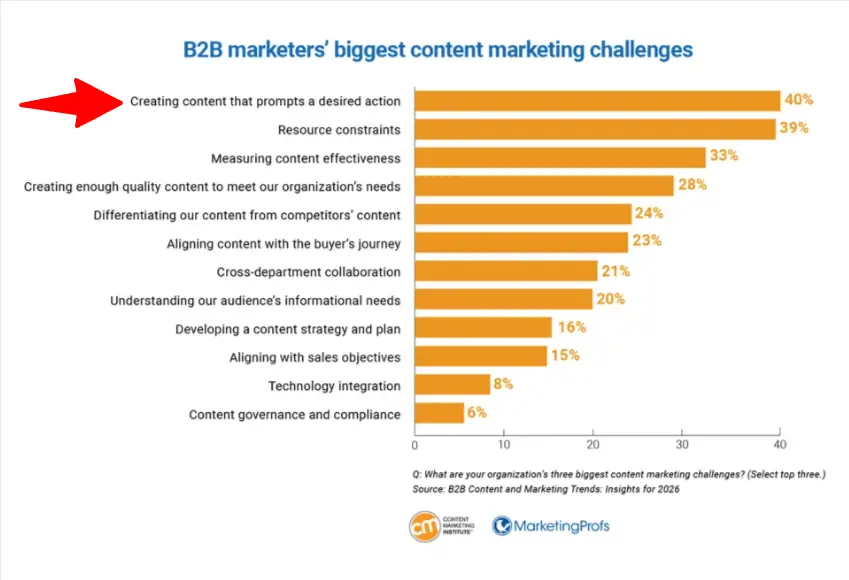
CMI’s 2026 B2B Content and Marketing Trends Research found that 33% of marketers cite measuring content effectiveness as a top-three challenge. And when you can’t measure what matters, you default to what’s easy to count, and that’s almost always traffic.
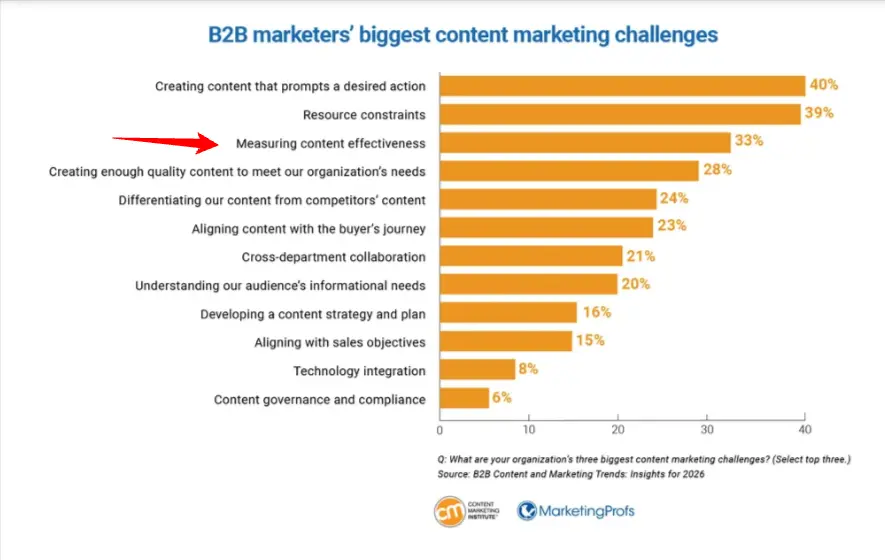
Source: CMI’s 2026 B2B Content and Marketing Trends report
Here’s a concrete example of why this is dangerous.
Blog post A gets 10,000 views with a 0.1% conversion rate, producing 10 leads.
Blog post B gets 2,000 views with a 2% conversion rate, producing 40 leads.
Post B is four times more valuable to the business, but in most reporting structures, Post A gets the spotlight because 10,000 is a bigger number than 2,000. The team doubles its effort on content like Post A, traffic climbs, and pipeline stays flat. This cycle repeats quarter after quarter, and nobody can figure out why content isn’t working.
6. Content Calendars Replace Content Strategy
Most B2B teams have a content calendar — a spreadsheet with publish dates, topics, formats, and assigned writers. Far fewer have an effective B2B content marketing strategy — a framework that connects every piece to a buyer journey stage, a business goal, and a measurement plan.
CMI’s 2026 B2B Content and Marketing Trends Report found that while 97% of B2B marketers say they have a content strategy, only 12% rate themselves as “highly effective” at content marketing. The top challenge? 40% say it’s creating content that prompts a desired action. Key takeaway: Having a strategy on paper and having one that actually drives conversion are two different things entirely. One can even deduce that what many B2B content marketers call a content strategy is actually a content calendar.
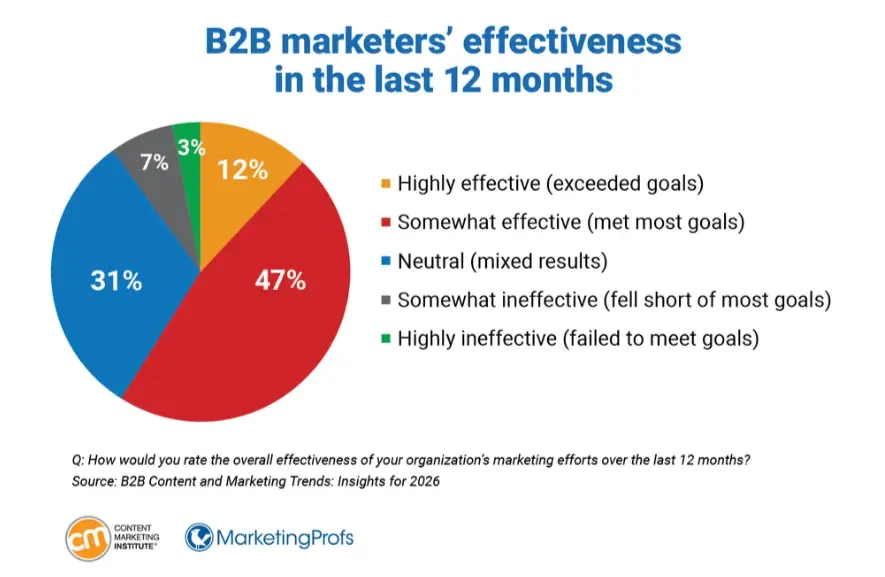
Source: CMI’s 2026 B2B Content and Marketing Trends report
Source: CMI’s 2026 B2B Content and Marketing Trends report
A calendar answers “what are we publishing this week?” A strategy answers “why does this piece exist, who is it for, and what should it make them do?” The calendar ensures consistency while the strategy ensures relevance. Understanding the relationship and differences between the two is crucial. Most teams have the first and mistake it for the second, which is how you end up publishing 200 blog posts a year with no measurable impact on the pipeline. Having a strategic approach to content is something I’ve written about in the context of how internal linking can improve year-round visibility because even solid individual pieces fail when they aren’t connected to a broader strategic framework.
If these problems sound familiar, reach out via LinkedIn to discuss how I can fix your content marketing system. If you would rather fix them yourself, this next section will help you.
Practical Ways to Create B2B Content That Wins
Producing more content rarely fixes why most B2B content fails. Connecting every piece you create to the business — to buyer questions, to revenue goals, to the real conversations your sales team is having every day — will.
Here are the practical ways I approach B2B content to make it work as a growth driver.
1. Start with business goals, not keywords
Every piece of content should start with a business question, not a keyword opportunity. That’s how you become a business-aware B2B content writer. Before you write anything, define four things: what business outcome this content supports, which buyer persona it targets, which journey stage it maps to, and how you’ll measure success.
This changes the entire content development process. Instead of starting with “best CRM for small business” because the keyword tool says it gets volume, you start with “we need to reduce trial-to-paid conversion friction for our SMB segment.” The content that comes from goal-first thinking looks fundamentally different. It’s sharper, more specific, and naturally aligned with something your business actually needs to achieve.
What you can do:
Adopt my simple framework for ensuring my B2B content supports a business outcome, targets a buyer persona, and maps to a customer journey stage. Ensure every piece gets a one-line brief before anything else happens. The format is straightforward: “[Content title] exists to [business goal] by helping [persona] at the [journey stage] understand [key message].” If you can’t fill in that sentence, the content doesn’t have a clear enough purpose yet. That one-liner becomes the filter for every editorial decision downstream: does this paragraph serve the stated business goal, or is it filler?
Tim Soulo, CMO & Product Advisor at Ahrefs, covers a similar concept that you should check out: Business potential: The most important metric in Content Marketing.
2. Build content around your point of view
Distinctive content starts with a belief, not a brief. Define three things: what assumption in your market you disagree with, what you believe instead, and what proof you have that your belief is correct.
For an enterprise integration vendor, that might look like this: “Most vendors in our space sell on features. I believe the real differentiator is implementation speed because our clients’ business continuity depends on it.” That single belief becomes the organizing principle for every piece of content you publish. Blog posts, case studies, webinars, and sales decks should all reinforce this perspective consistently.
What you can do:
Test your point of view with one question: would a competitor be comfortable saying the exact same thing? If the answer is yes, your POV isn’t distinctive enough. A real point of view creates some discomfort because it draws a line. It says, “this is what we believe, and we’re willing to be measured against it.” That’s what earns trust, and that’s what makes content memorable enough to influence a buying decision weeks or months after someone reads it.
3. Translate features into business outcomes
B2B buyers don’t buy features. They buy outcomes — the specific, measurable improvements that a product or service creates for their organization. Content that lists what a product does instead of showing the problem it solves will consistently underperform, because the reader is left doing the translation work themselves. Most of them won’t bother.
Joe Lazauskas, author of Super Skill: Why Storytelling Is the Superpower of the AI Age, described this problem directly in his substack: “For two decades, marketers have been obsessed with creating generic blog posts like ‘What is Content Marketing?‘ in hopes of driving cheap traffic that rarely converts.”
The fix is outcome-led content that addresses the problem the buyer actually needs to solve, not what the product technically does.
The difference shows up immediately when you rewrite feature-led copy. Here is one good example.
Feature-led: Our ERP solution includes automated data reconciliation.
Outcome-led: Your finance team stops spending 15 hours a month on manual reconciliation, your CFO closes the books faster, and reporting errors drop across the board.
The second version doesn’t mention the feature differently; it tells the reader what changes in their work life.
What you can do:
For every feature you mention in content, add the “so what.” What does this mean for the person reading it, and what measurable improvement does it create? It becomes easier to answer the so what when your content is problem-first content tied to a business goal.
4. Use internal data to drive content decisions
The best content topics don’t come from keyword tools alone; they come from internal data that your competitors don’t have access to. Google Search Console queries show you what people are actually searching when they find your site. Sales call transcripts reveal the questions and objections that come up repeatedly. CRM objection fields capture the specific reasons deals stall. Customer support tickets show where users struggle after buying. Product usage data highlights which features get adopted and which get ignored.
Each of these is a content signal. If GSC shows consistently high impressions for “how to reduce customer churn with [your product category],” it’s clear evidence of existing demand that you’re not fully capturing. The content that addresses that specific query will outperform a generic “customer retention tips” post because it’s grounded in what real potential buyers are already looking for.
What you can do:
Make this systematic by building content engineering workflows that extract content topic insights from your sales calls, GSC data, customer support tickets, product usage data, and CRM. Schedule a weekly or monthly data pull and build a shared document where these insights feed into. When content topics come from internal data, they’re harder for competitors to replicate and more likely to address what your actual buyers care about.
I build content engineering systems like this on AirOps. Check out this workflow I built that turns sales notes in Notion into SEO blog articles and LinkedIn posts written back to a folder in your Notion workspace.
5. Write for the buying committee, not “the buyer”
Every piece of content should map to a specific role within the buying committee. For large-ticket B2B purchases, you need content layers — one that addresses the champion’s pain, one that satisfies the evaluator’s requirements, and one that builds the executive’s business case.
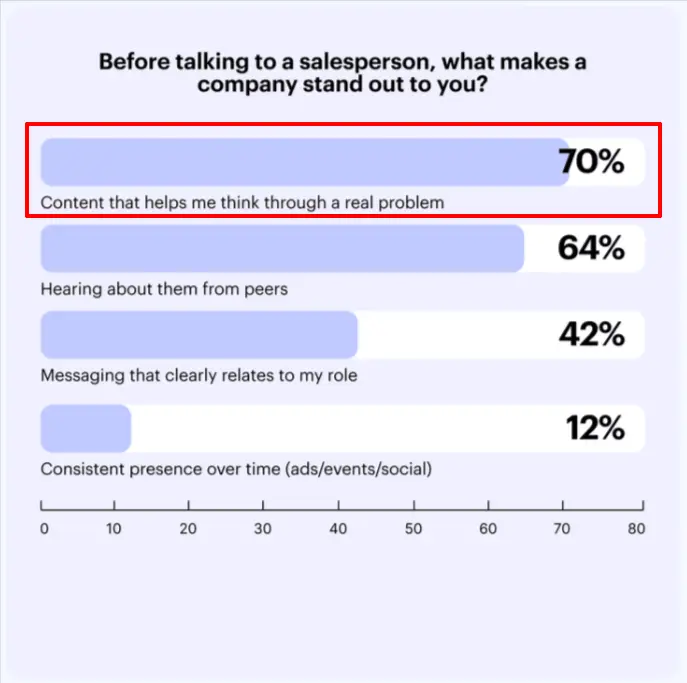
Influ2’s 2026 Enterprise Buying Survey found that 70% of B2B buyers say the top thing companies can do to stand out is provide content that helps them work through a real problem, specific to their role and situation.
Source: Influ2’s 2026 Enterprise Buying Survey
And 74% of those buyers evaluate 3 to 5 vendors simultaneously.

Source: Influ2’s 2026 Enterprise Buying Survey
Generic account-level messaging doesn’t differentiate you from anyone on that shortlist. Role-specific content does.
You can apply this for an enterprise integration company, for instance, by developing separate content tracks:
- Case studies showing business outcomes for the CTO
- Technical walkthroughs for the implementation team, and
- ROI calculators for the finance lead.
Each piece will address the same product from a completely different angle. These different angles will help the different members of the buying committee get the answers they need to approve the purchase.
What you can do:
Start by creating a buying committee map for your top product. List each role involved in the decision, their primary concern, and the content format that serves them best. This map becomes your content planning backbone, telling you exactly which gaps to fill instead of guessing what to write next.
6. Collaborate across teams to ground content in reality
The best B2B content that wins comes from the intersection of product knowledge, sales intelligence, and marketing skill. Writers who only pull from keyword research and competitor analysis are working with a fraction of the insight available to them. The most valuable inputs — what prospects actually ask, what objections stall deals, what features customers love or ignore, etc. — all live inside sales, product, and customer success departments.
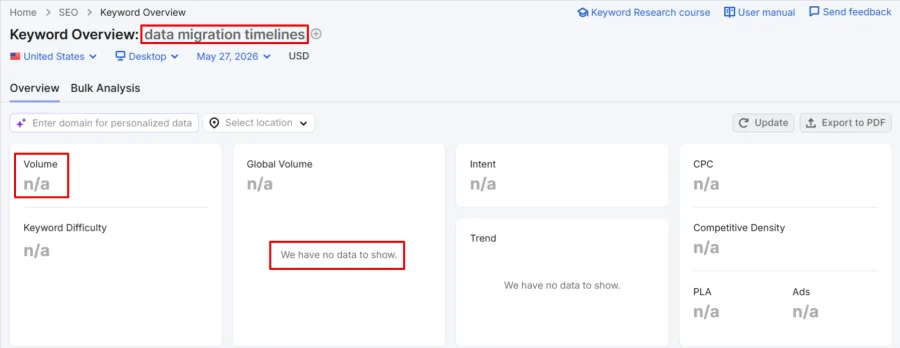
I also experienced this directly with the enterprise integration company. The sales team flagged that prospects were consistently asking about data migration timelines, a topic the content team hadn’t touched because it didn’t show up in keyword research as a high-volume opportunity.
Source: Semrush
Ironically, this ‘zero volume keyword’ was a huge objection affecting sales close rates.
We built an entire content series around migration planning: timelines, risk mitigation, and vendor evaluation criteria. Those pieces became the most-used sales enablement assets the company had, because they answered the exact questions that were coming up in real buying conversations.
What you can do:
Set up a recurring 30-minute sync between content, sales, and product. Keep it simple with one question to always ask: “What’s the most common question or objection you heard this month?” That single question generates content ideas grounded in what buyers actually care about — their evolving problems — and builds the cross-functional trust that makes content a shared priority instead of a marketing-only function.
7. Measure what matters — pipeline, not page views
Content measurement needs two tiers. Leading indicators: time on page, scroll depth, CTA clicks, form fills, etc., which tell you whether content is engaging the right audience. Lagging indicators: pipeline influence, demo requests, deal velocity, revenue attribution, etc., which tell you whether content is contributing to business outcomes. Both matter, but the lagging indicators are what determine whether your content program earns continued investment.
Connecting lagging indicators to content marketing can be a challenge, which is why marketers naturally default to measuring only leading indicators. But then, stakeholders need to know the level of influence content marketing has on the pipeline and revenue, beyond leading metrics.
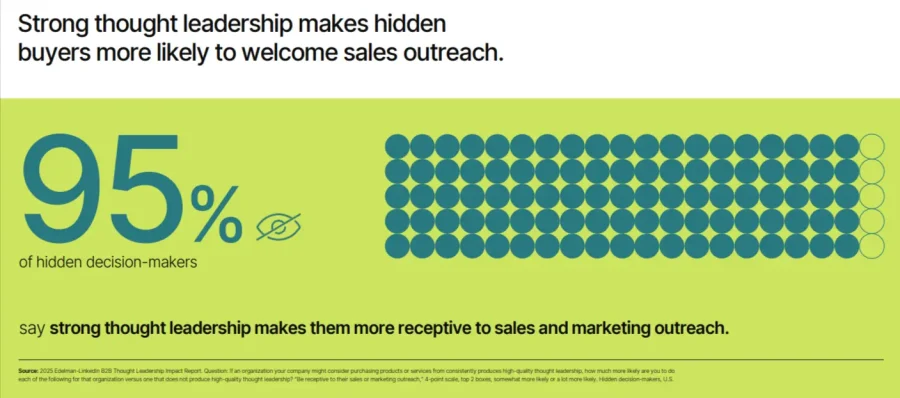
Here is an interesting report. The LinkedIn and Edelman’s 2025 Thought Leadership Impact Report team surveyed 1,934 global management-level professionals across a wide range of industries and company sizes and found that 95% of hidden buyers, stakeholders with major sway in buying groups, say strong thought leadership makes them more open to outreach.
Source: LinkedIn and Edelman’s 2025 Thought Leadership Impact Report
This is the kind of influence that traffic metrics will never capture. A prospect who reads your content, trusts your perspective, and agrees to a meeting six weeks later doesn’t show up as a conversion in your analytics dashboard, but they absolutely show up in your pipeline.
What you can do:
Resist the urge to celebrate traffic alone. A piece of content that generates 500 views and 15 demo requests is more valuable than a content that generates 50,000 views and zero pipeline activity. Add UTM parameters to your content CTAs and set up pipeline attribution in your CRM so you can track which content touches influence closed deals. When you measure pipeline instead of page views, you stop optimizing for volume and start optimizing for impact. That shift reshapes how your content program prioritizes and plans.
Further reading: B2B Content Writing That Moves the Needle: My Work and Results
You Win When You Connect B2B Content to Buyer’s Questions and Your Business Goals
Your B2B content will fail when it’s disconnected from the business: when you optimize for traffic instead of pipeline, publish without a point of view, write for a generic buyer instead of a buying committee, and/or measure success by vanity metrics instead of revenue influence. To start winning with B2B content, always start with the business outcome and your audience’s problem and work backward through every editorial decision. That takes cross-functional alignment, internal data, and the discipline to say no to content that doesn’t have a clear purpose.
If your B2B content isn’t driving pipeline, reach out via LinkedIn now to discuss how I can help.
Frequently Asked Questions on Why B2B Content Fails
Why does most B2B content get traffic but no leads?
Most B2B content targets high-volume keywords that attract informational searchers, not buyers. A blog post ranking for “what is project management” draws students and job seekers, not enterprise decision-makers evaluating tools. The content succeeds on traffic metrics but fails on revenue metrics because keyword volume and buyer intent were treated as the same thing. To fix this, map your content to buyer questions at specific journey stages, where commercial intent actually exists.
What makes B2B content actually convert?
Your B2B content converts when it addresses a specific buyer’s problem at the right stage of their decision process. That means starting with the buyers’ problem and an aligned business goal instead of a keyword, writing for a defined role within the buying committee, leading with a clear point of view, and measuring success against pipeline contribution. Content that converts also draws from internal data from sales objections, customer questions, and product usage patterns. Those insights make the content relevant enough to prompt action.
How do you know if your B2B content is solving the wrong problem?
Check whether your content topics come from keyword research alone or from actual buyer conversations. If your content team can’t name the top three objections that stall deals for your business, they’re probably writing about topics that seem relevant but don’t address what buyers actually think about during the decision process. The clearest signal is high traffic with low conversion; it means you’re attracting an audience, just not the one that buys.
Is educational content bad for B2B?
Educational content isn’t bad; disconnected educational content is. A well-positioned educational piece that teaches a buyer something relevant to the problem your product solves can build trust and move them closer to a decision. The issue is when educational content exists in isolation, without connecting to your product’s value or the buyer’s next step. Every educational piece should have a clear “so what” that ties back to the business outcome your reader cares about. My problem-first content approach is built around helping buyers learn how to solve their problems with your solution.
How long does it take for B2B content to start generating leads?
Content-to-pipeline timelines vary by industry, deal complexity, and sales cycle length, but most B2B content programs need two to six months of consistent content marketing before pipeline impact becomes measurable. Individual pieces targeting high-intent keywords can generate leads faster, sometimes within weeks. The key variable is whether the content maps to active buyer questions or to broad informational queries. Intent-aligned content shortens the timeline significantly.
What is the biggest mistake B2B companies make with their content strategy?
Treating a content calendar as a content strategy. Most B2B teams have a schedule of topics, formats, and publish dates, but they lack a framework connecting each piece to a buyer persona, a journey stage, a business goal, and a success metric. The result is consistent publishing with inconsistent impact. A strategy answers “why does this piece exist and what should it make the reader do?” A calendar only answers “what are we publishing this week?“
How is B2B content different from B2C content?
B2B content serves longer sales cycles, larger buying committees, and higher-stakes purchases. While B2C content often drives immediate action from individual consumers, B2B content needs to influence multiple stakeholders across weeks or months. B2B buyers conduct extensive independent research, evaluate several vendors simultaneously, and require role-specific information: the CFO needs ROI data, the technical lead needs integration specs, and the champion needs a compelling internal pitch. Effective B2B content accounts for this complexity rather than treating “the buyer” as a single person.




Excellent breakdown. This article does a great job of identifying why so much B2B content misses the mark. Moving from ‘company-first’ to ‘audience-focused’ is a shift many brands still struggle with, and these practical steps make that transition much clearer. A valuable read for anyone looking to drive real engagement.
I’m glad you found this valuable, Enndra.