
Your writing skills alone don’t make you a great B2B content writer. 60–70% of B2B content goes unused by sales and fails to generate revenue because most content is written without business understanding. The gap between being competent and being indispensable is knowing how to balance solving prospects’ problems, meeting the company’s business goals, and writing good content. You need to be business aware to thrive at the center of this mix. This guide shows you how to build the level of business awareness that transforms you into a revenue-driving B2B content writer.
Key Takeaways
- Most B2B writers don’t understand business. They chase vanity metrics and fail to connect content to pipeline or customer acquisition.
- Structural barriers keep writers in the dark: limited data access and briefs that reduce them to order-takers rather than strategic contributors.
- Business-aware B2B content writers combine strategic thinking with the ability to translate complex products into outcomes for specific stakeholders.
- Building business awareness requires learning business and marketing fundamentals and practicing consistently.
- The writers who earn the highest rates and retain clients the longest understand the pipeline, not just writing. Every sales call and CRM dashboard you study makes your next piece sharper.
- Business awareness compounds; it turns you from someone who fills content calendars into someone who fills pipelines.
What It Means to Be a Business-Aware B2B Content Writer
A business-aware B2B content writer understands the company’s business model and buyer journey well enough to write content that influences purchasing decisions and drives measurable results. You don’t need to become a strategist or a marketer; you only need to know enough of the business landscape to write content that moves buyers from awareness to a closed deal. Honestly, it’s a skill that takes time to master.
Most B2B writers were hired for their writing craft. The result is often content that reads well but sits unused, disconnected from the pipeline and invisible to the sales team that’s supposed to use it. No business impact.
The gap between writing well and writing for business impact
Strong writing is table stakes; the gap that separates competent B2B writers from indispensable ones is whether the content connects to revenue. And that’s where things get complicated for a lot of writers and B2B content writing recruitment teams.
The data tells a stark story. SiriusDecisions (now Forrester) found that 60–70% of B2B marketing content goes unused by sales teams. That research was first published in 2014, but Forrester and industry practitioners have confirmed the pattern holds through 2026. Most B2B content gets produced and ignored because it was built without buyer intelligence, thus, not good for sales enablement.
The disconnect runs deeper than content quality, as highlighted by Pipeline360’s 2026 State of B2B Marketing Content report (gated report, but it’s worth your time). The survey of 555 marketers across six countries found that only 19.1% of B2B marketers track pipeline contribution as a content KPI. Meanwhile, 54% describe their content strategy as “advanced.” The most common KPIs? Page views (40.4%) and social media followers (39.3%).
I like Matt Hummel, CMO of Pipeline360’s, commentary on the problem:
“A lot of teams mistake motion for maturity. They are producing more content and moving faster. That does not necessarily mean they have a better understanding of what content is actually responsible for.”
Matt Hummel – CMO, Pipeline360
For a B2B content writer, this data means something specific: If you don’t understand how the business works, it becomes easy to default to what’s easy to measure, traffic and engagement, rather than what actually matters. And when the chickens come to roost, it’s easier to be blamed for why the B2B content program isn’t working, especially when you can’t prove how the traffic, page views, and followers translate to business revenue.
AI tools widen, not fix, the business awareness gap
AI tools widen the business awareness gap rather than closing it. A writer who doesn’t understand the business will use AI to scale what isn’t working. More generic feature lists and keyword-stuffed blog posts that sales teams never touch.
Matt Hummel framed it directly in the same Pipeline360 report:
“AI amplifies whatever operating model is already in place. Without clear accountability and defined outcomes, it scales noise. With them, it becomes a force multiplier for clarity and performance.”
The implication is clear for B2B content writers: Use AI tools as an accelerator, not a substitute. A business-aware writer who uses AI to draft faster and iterate more efficiently produces better content at a higher volume. A writer without a business context uses the same tools to produce more noise at higher volume. The technology magnifies the gap between business-aware and business-blind writers; it doesn’t close it.
Why most writers never develop business awareness
Structural and cultural barriers keep writers disconnected from the business context they need. However, breaking the barriers falls on the B2B content writer regardless of who created the barriers.
I engaged some of my B2B content writing colleagues on LinkedIn, and they shared similar sentiments on why these gaps exist in the first place.
In the words of Faridah Giwa-Bello, content marketing specialist & SaaS writer:
“When writers are brought in only as wordsmiths, the system quietly tells them: ‘Just write. Don’t ask why.’ Then we’re surprised the content doesn’t move the needle.”
Nokrach Gerard Trevor, content strategist & SEO specialist for B2B SaaS, shares an adjacent thought:
“Without access to sales calls and CRM data, content stays tactical instead of revenue aligned. Writers need business context to drive impact.”
The overarching theme is that structurally, writers are kept at arm’s length from the business context they need. They’re handed thin briefs instead of CRM data and expected to produce without access to the pipeline intelligence that would make their content useful. B2B content writing freelancers and B2B writers at agencies face an even steeper hill: a product one-pager and a keyword list are often the entirety of what they receive.
This structural/cultural issue isn’t isolated; it’s a global problem.
Radix Communications’ Barriers to Great B2B Content Survey, a study of 105 B2B marketers, quantified the problem: 78% of respondents said customer access is a challenge, and 86% reported departmental co-operation issues. Mind you, these 105 B2B marketers were B2B content marketers of all levels, from all around the world. CMOs and marketing directors to content writers and agency types, working in all kinds of B2B: tech, engineering, SaaS, legal, manufacturing, and more.
One B2B content writer in the UK captured the frustration precisely:
“I don’t always know what terminology to use with the target audience, or what level of knowledge they already have.”
I personally love how Doug Kessler, Creative Director and Co-founder of Velocity Partners, framed the implications of this structural challenge in the same survey:
“If your stakeholders are not in alignment, nothing is possible. And if they are, almost anything is.”
The takeaway for writers: When you wait for someone to hand you business context, you’re already behind. The writers who break through these barriers are the ones who actively seek out the information, push back on thin briefs, and request access to the data that makes their content useful. Business awareness starts with refusing to write blindly.
It’s not an easy road, but then:
Ask, and it shall be given you; seek, and ye shall find; knock, and it shall be opened unto you. For every one that asketh receiveth; and he that seeketh findeth; and to him that knocketh it shall be opened.
Matthew 7:7-8
Looking for a business-aware B2B content writer who understands content strategy, marketing, and engineering? Reach out via LinkedIn now to discuss your content needs.
The Skills That Make You a Business-Aware B2B Writer
Business awareness shows up in specific, learnable skills that separate writers who produce content from writers who produce results.
Know the ICP and the buying committee — then write for them
A B2B content system built for a generic buyer serves no one on the buying committee effectively. Because every B2B purchase involves multiple stakeholders with different priorities and levels of authority, you need to build content with multiple content angles. Before you write a single word, know who’s reading.
Take a CRM solution. The implementation engineer cares about integration complexity and training load. The CTO cares about long-term ROI and security posture. Both roles care about the same product but require completely different content angles. A business-aware writer produces both and knows which angle serves each stakeholder and stage of the buying journey.
What to do: Before drafting, build a buyer persona and write down the exact job title and details of the person you want to read your piece. What problem keeps them up at night? What objection will their boss raise when they pitch this solution internally? If you can’t answer those questions and other buyer persona questions, you’re not ready to write. I understand time is always a constraint, especially for writers on lean content teams. But, at least, have a fictional understanding of your target persona.
Connect every piece to a business objective
Any piece you write, regardless of format, should serve a business goal beyond traffic. Before you start writing, know the answer to one question: what business outcome does this piece need to create?
Know specifically whether the piece is meant to drive demos or support mid-funnel leads who’ve already evaluated competitors, and whether sales will use it directly in prospect conversations. Each answer changes how you structure the piece and what action you ask the reader to take.
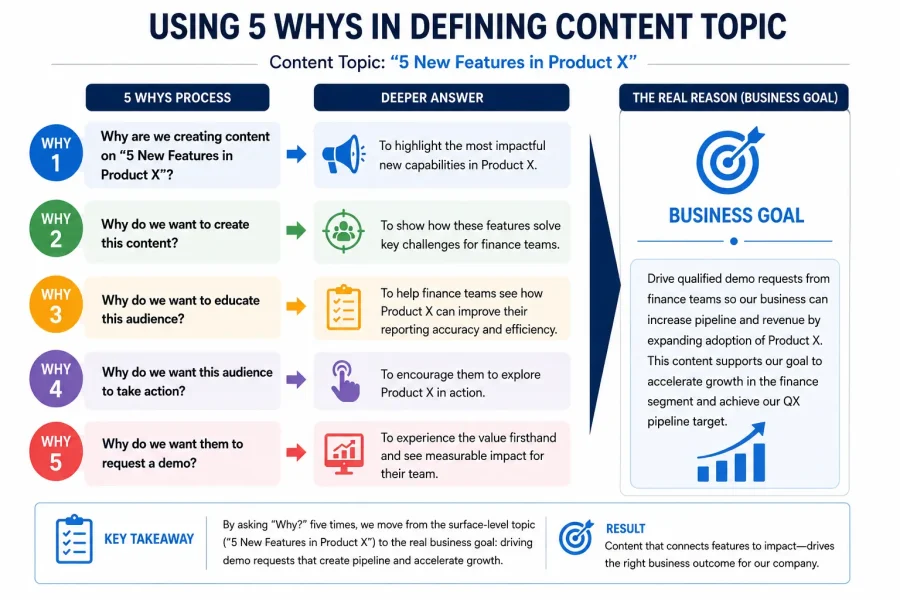
Consider this example. A use case article showing how a finance team reduced reporting errors by 40% and cut month-end close time by two days, with a demo CTA tied to that specific workflow, is content built on business understanding. A generic feature list blog post titled “5 New Features in Product X” doesn’t serve your pipeline.
What to do: Always ask your client or manager one question before every brief: “What business outcome does this piece need to create?” If they can’t answer, push back until they can. You can borrow ideas from the 5 Whys Framework to identify a ‘root goal’ for the content. That single process will do more for your content quality than any level of research or writing.
Source: ChatGPT
Use data to decide what to write and how to write it
Internal analytics, from Google Search Console to CRM dashboards, reveal where the money is. Writers who access and interpret this data make fundamentally better decisions about topics and positioning than writers who rely on keyword tools alone.
Luke Marthinusen, Founder and CEO at MO Agency, in his LinkedIn post, described what it looks like when content decisions start from revenue data instead of editorial calendars:
What to do: Check which content pieces influenced closed deals, not which ones got the most traffic. Write more of the type of content that closes deals and reduce the amount of resources you invest in low-value content. Collaborate with sales, customer success, and product teams to review sales notes, customer FAQs, and ongoing customer objections. Insights like this will help you produce timely and strategic content that will increase your pipeline.
Which brings me to…
Bridge the gap between content and other teams
You can’t write business-aware content in isolation. The objections buyers raise and the specific moments where deals stall don’t live in a keyword research tool. They live in conversations between your company and its customers. And to have access, you need to sit in on sales calls and read account manager feedback; every conversation surfaces objections and angles you’d never discover from a brief.
Lina Navickaite, founder & creative director at Smartup Visuals, commenting on Marthinusen’s LinkedIn post, put it sharply:
“Content isn’t a marketing asset; it’s a sales intervention. If it’s not tied to a real objection or a real deal stage, it’s just noise with a logo on it.”
What to do: Mirror the exact language prospects use in your content: their phrasing, their hesitations, their comparisons to competitors, etc. Buyers trust content that sounds like it was written by someone who understands their world, because it was.
Translate complex products into outcomes — not features
Decision-makers don’t buy features; they buy the results those features create. Repeat that twice. Your job as a business-aware content writer is to translate technical capabilities into business outcomes that resonate with the buyer persona(s).
For instance, instead of writing, “automated data reconciliation feature,” you can use something like: “Your finance team eliminates hours of manual review each month, and your CFO closes the books faster with fewer bottlenecks.“
The first version describes what the product does, while the second describes what the buyer gets. You must understand that distinction if you want to be a business-aware B2B content writer.
What to do: Here is a tip that works for me. Should work for you too. For every feature you mention, complete this sentence: “Which means [specific stakeholder] can now [specific outcome].” If you can’t complete it, you don’t understand the feature well enough to write about it. Go back to the product team and ask.
How to Build Business Awareness as a B2B Content Writer
You build business awareness consciously through deliberate practice — specific habits and learning that compound over time. The B2B content writers who invest in becoming business-aware consistently become the ones clients can’t afford to lose.
Take courses in business fundamentals and marketing strategy
Formal learning accelerates the process. You don’t necessarily need an MBA, but you do need foundational knowledge in how businesses operate and how marketing drives the pipeline.
I recommend you start with these areas:
- Business fundamentals: Learn how companies generate revenue, including pricing models and unit economics like Customer Acquisition Cost (CAC) and Lifetime Value (LTV). Understanding these concepts changes your mentality and approach to content writing.
- Marketing strategy: Learn the fundamentals of competitive analysis, market positioning, demand generation, etc. Understanding where your client fits in the market and how marketing drives pipeline equips you to be able to turn a brief from a set of instructions into a strategic opportunity.
- Sales enablement: A personal favorite. Go deep into understanding how sales teams use content and how objection handling maps to deal stages. Knowing the role of content in improving sales and the role of sales in informing strategic content means you stop writing content that sales ignores and start writing content they forward to prospects.
Platforms like Coursera and HubSpot Academy offer courses across all of these. You don’t need to become a marketer or a salesperson; you only need to understand their world well enough to write content that serves it.
Learn how the product makes money
Knowing how your client’s product makes money is one of the fastest ways to sharpen every messaging decision you make. For instance, understanding the pricing model and competitive positioning helps you decide whether you emphasize long-term ROI or quick implementation wins.
Actionable tip for B2B writers: Ask your client two questions before you start: What’s the most common reason prospects don’t buy, and what upsell drives the most revenue? The answers change how you write. A product where the main objection is implementation complexity needs content that addresses implementation and onboarding. A product where the main upsell is an analytics add-on needs content that informs prospects about that early on.
Here is a practical example for you.
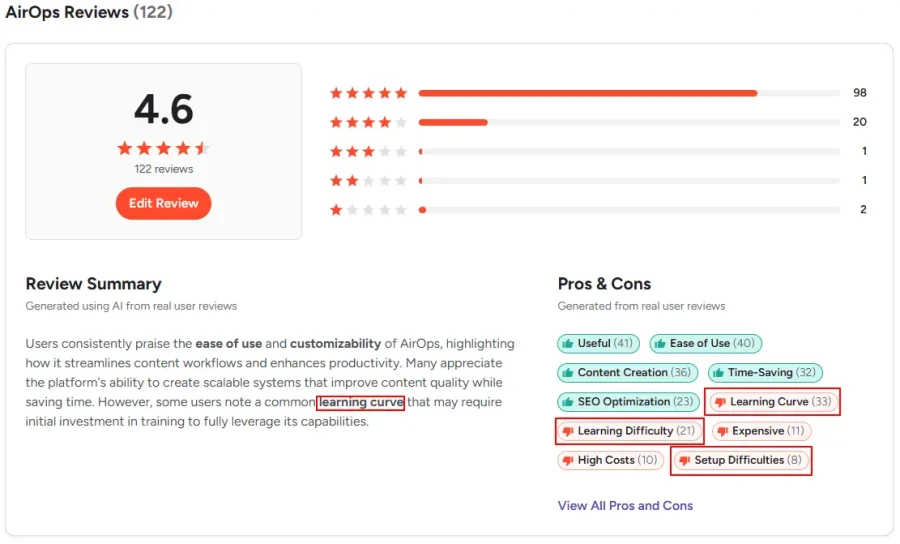
AirOps is arguably the best platform for automating content marketing and engineering and winning in AI search. However, a lot of G2 reviewers complained about the learning curve.
Source: G2
Seeing this common theme, which is a huge objection to adoption, AirOps launched FREE cohort programs and AirOps University, where instructors teach content engineering fundamentals and how to use AirOps to build marketing workflows and win in AI search. Graduates get free content engineering certificates and diplomas.

Source: AirOps University
Sit in on sales and customer success calls
Sitting in on sales and customer success calls is one of the fastest shortcuts to writing like a business-aware B2B content writer. Real buyer conversations reveal objections and language that no brief or keyword tool can replicate.
I love how Clare Plaister, founder of Language Travel Tours, described it succinctly:
“The fastest content ROI I’ve ever seen came from objection logs, not brainstorms. If marketing isn’t sitting inside sales conversations, it’s guessing.”
If you read Luke’s LinkedIn post from above, there is a particular section that reinforces the importance of sitting in on sales and customer success calls, from his own experience:
“Every single piece of content we needed came from the people actually selling. Not from marketing brainstorms, content gurus’ templates, or a calendar built in total isolation from reality.”
Actionable tip for B2B writers: If you’re an in-house writer, request access to these calls. If you’re a freelancer or agency and can’t access calls directly, ask for anonymized call transcripts or a top-five objection list from the sales team. Even a summary of the three most common reasons prospects say “not yet” gives you more to work with than any content calendar or brief.
Analyze competitor content through a business lens
Competitor content analysis done at the business level reveals positioning gaps that keyword-level analysis never surfaces. Go beyond surface-level metrics like keyword coverage and format matching — the typical Skyscraper Technique analysis. Understand what competitors are positioning and where they’re being vague; identify the claims they can’t back up. That can be your gap, for instance.
Actionable tip for B2B writers: For each competitor piece, identify the main business claim they’re making and assess whether it holds up — vagueness or lack of evidence is your opening. Every gap you find is an opportunity to write something more specific and more useful to the buyer. Go deep and expand on the idea, driving home your message while positioning your product.
Adapt your approach: freelancer vs. in-house
Business awareness looks different depending on whether you’re working in-house, as a freelancer, or in an agency working across multiple clients.
In-house writers have the advantage of depth. You can attend recurring sales meetings and track pipeline data across quarters, not just individual campaigns. The risk here is tunnel vision, because you’re too close to the internal narrative. You can push against that by regularly reviewing competitor positioning, staying updated with relevant industry benchmarks, and talking to customer-facing teams outside your usual contacts.
Freelance and agency writers face the opposite challenge: breadth without depth. You serve multiple clients but rarely get the access an in-house writer takes for granted — no standing invite to sales calls, no CRM login, no Slack channel with the product team. You can compensate by front-loading your onboarding. Before the first draft, request a 30-minute call with someone in sales or customer success. Ask for the top objections prospects raise and the primary competitor they lose deals to. That single conversation can give you more business context than most freelance briefs provide in six months.
Both paths lead to the same destination: writing that connects to revenue. The tactics differ, but the commitment to understanding the business doesn’t. And the business awareness that comes with understanding the business makes you a standout B2B content writer.
Practice translating features into value, consistently
Practicing how to translate product features into value consistently is the core muscle of a business-aware B2B content writer. Do it for every piece and every draft, not occasionally when you remember.
Actionable tip for B2B writers: Keep a running “feature –> value” translation document. Every time you learn a new product feature, write the buyer outcome next to it and review it before every draft. Over time, this document becomes your most valuable writing asset — a library of business-aware angles you can deploy instantly. You can learn more about translating features into valuable business outcomes.
You want your target B2B buyers to have your product’s value stuck in their heads because B2B buying decisions are shaped long before a buyer fills out a demo form.
95% of B2B buyers aren’t actively in-market at any given time, and 95% of winning vendors appear on the buyer’s Day One shortlist. The content you write today shapes whether the brand is on that shortlist when the buyer is finally ready.
LinkedIn B2B Institute and Ehrenberg-Bass research on “The 95-5 Rule“.
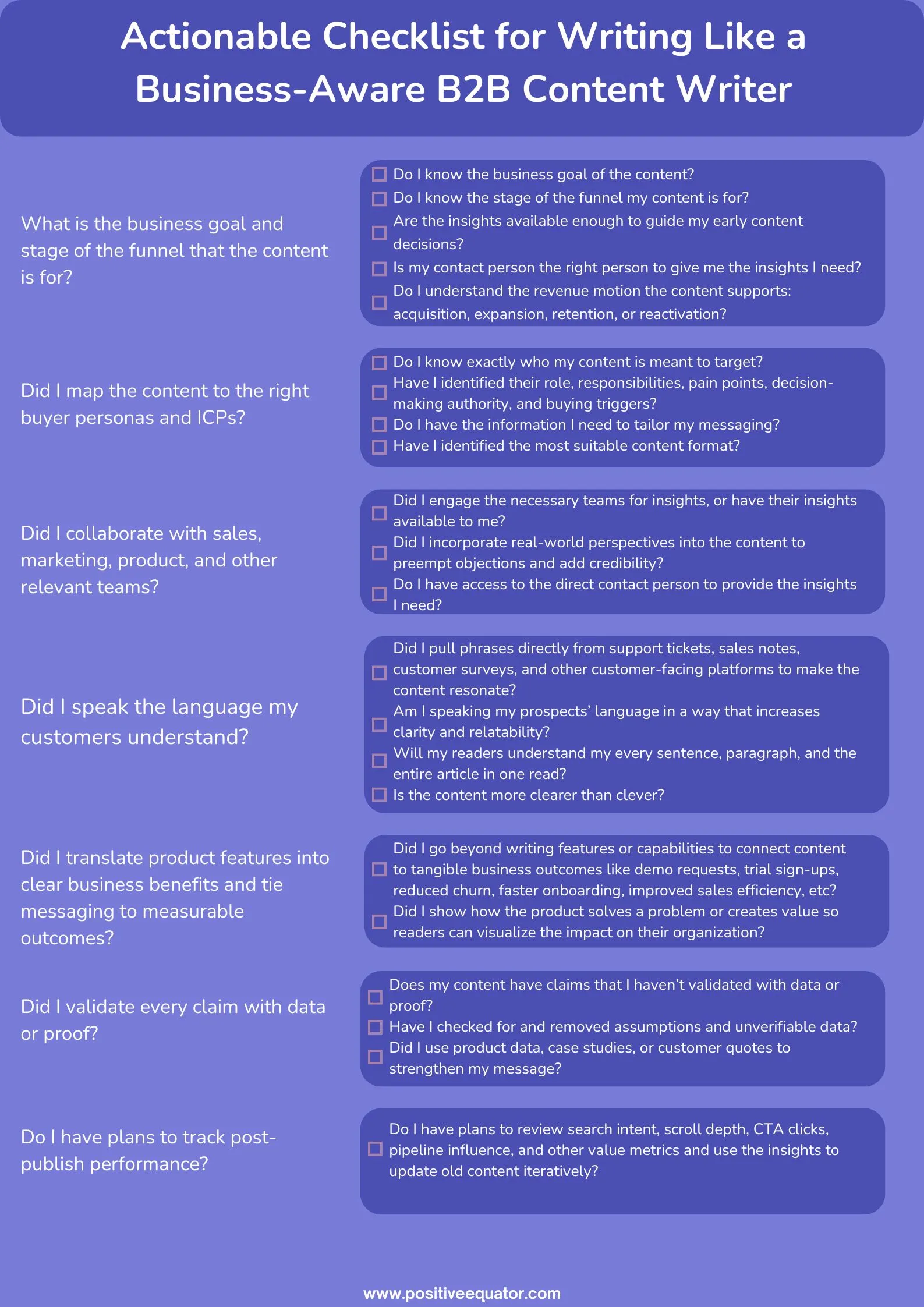
Actionable Checklist: Writing Like a Business-Aware B2B Content Writer
Applying business awareness starts with a set of concrete habits you run before and after every draft.
- Confirm the business objective and funnel stage before you start drafting
- Identify the specific buyer persona and their role in the buying committee
- Match the content format and depth to where the buyer is in their decision process
- Ask sales or customer success for real buyer language and objections
- Lead with outcomes and value, not features or jargon
- Write for the person making or influencing the buying decision, not for the search engine
- Back every claim with data or a named source
- Translate every product feature into a measurable business benefit
- Include a clear next step that aligns with the content’s business goal
- Review post-publish performance on pipeline metrics, not just traffic.
Start Writing Like a Business-Aware B2B Content Writer
B2B content writing is a business skill, not just a creative one. The writers who drive revenue understand the business model and translate complex product features into outcomes buyers care about.
Business awareness isn’t a nice-to-have; it’s what separates content that fills a calendar from content that fills a pipeline. Build it deliberately and practice it consistently, and your writing will do more than rank; it’ll influence purchasing decisions and earn you a seat at the strategy table where content decisions actually get made.
And if you’re looking for a business-aware B2B content writer? Reach out via LinkedIn now to discuss how I can help.
FAQ on Being a Business-Aware B2B Content Writer
What is a business-aware B2B content writer?
A business-aware B2B content writer understands the audience’s pain points and the company’s business model and revenue goals, not just writing best practices. They create content aligned to specific business objectives and buyer stages, translating complex product features into outcomes that influence purchasing decisions. Business-aware writers optimize for pipeline contribution and sales enablement value, not traffic alone, because those metrics reflect actual business impact.
How is B2B content writing different from B2C?
B2B writing targets logic-driven decisions involving multiple stakeholders over longer buying cycles, often weeks or months. B2C content appeals to individual emotion and impulse. B2B content writers must understand the buying committee and map content to deal stages, speaking to different roles — from the CTO to the end user — each with different priorities. Success metrics differ accordingly: B2B measures pipeline influence, not just clicks.
What skills does a business-aware B2B content writer need?
A business-aware B2B content writer needs strategic thinking and the ability to translate technical features into buyers’ business outcomes. You also need foundational knowledge of business and marketing strategy, enough to understand the commercial context your content operates in. Cross-functional collaboration with sales and product teams is crucial, as is combining strong craft with business acumen. These skills help you retain clients longer and command premium rates.
How do you measure B2B content success?
Focus on pipeline influence and lead quality, not traffic alone. Track which content pieces appear in closed-deal journeys and which ones sales reps actually send to prospects. The writers who insist on measuring what matters and adjusting based on those metrics produce consistently better results. Sadly, only 19.1% of B2B marketers track pipeline contribution, according to Pipeline360’s 2026 report.
How can I become a more business-aware B2B content writer?
Take courses in business fundamentals and marketing strategy. Sit in on sales calls and study your client’s CRM data. Learn the product’s pricing model and competitive positioning. Analyze competitor content through a business lens. Build a habit of translating every feature into a buyer outcome for every piece you write. Business awareness compounds: every sales conversation and pipeline review you sit through makes your next draft sharper and more commercially effective.